


Supply Capacity That Meets Customer Expectations


Supply Capacity That Meets Customer Expectations
We’re prepared for all kinds of risks, to ensure a stable, long-term supply of high-quality products.
Flexible and Agile Responsiveness to Meet Our Customers’ Diverse Needs
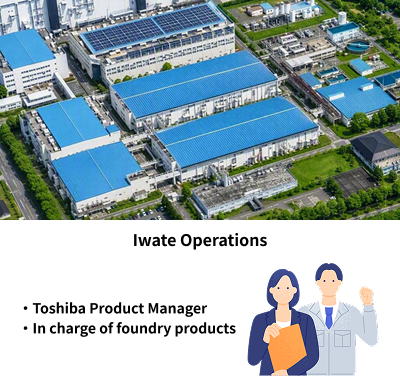
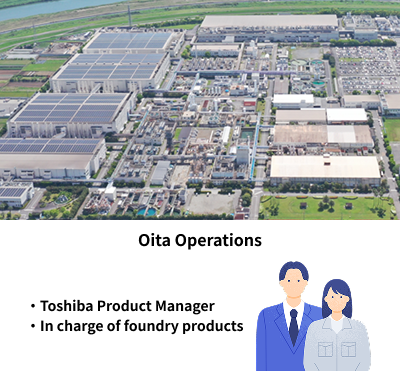
Dedicated staff members for Toshiba products and foundry products at both our Iwate and Oita Operations facilities enable us to provide agile and flexible support, to meet our customers’ diverse needs and ensure swift prototyping and mass production.
We are committed to providing our customers with solid support amid diversifying market needs and a rapidly changing business environment.
We are committed to providing our customers with solid support amid diversifying market needs and a rapidly changing business environment.
Two production lines to minimize the risk of supply disruptions
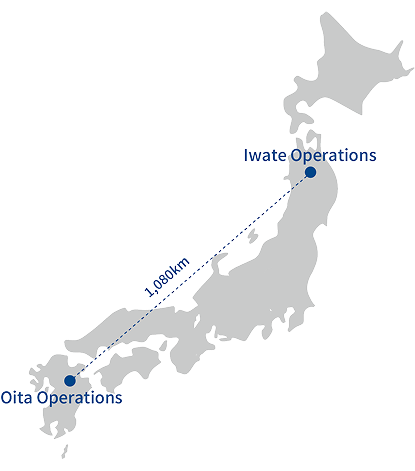
Our Operations facilities in Iwate and Oita Prefectures are a straight distance of 1,080 km apart, and we are building a parallel production system that will allow production to continue at the other facility if one of them is affected by a disaster.
Earthquake Preparedness Measures Drawing on the Lessons of the Great East Japan Earthquake
| Measures | Oita Operations | Iwate Operations | |
|---|---|---|---|
| Manufacturing Equipment | Implementation of an Earthquake Damage Mitigation System | Resolved | Resolved |
| Measures to prevent photomasks from falling | Resolved | Resolved | |
| Diffusion furnace: Measures to prevent quartz breakage (Stockpiling spare parts, installing seismic isolation mounts, etc.) |
Continuing measures | Continuing measures | |
| Buildings/Facilities | Reinforcement of anti-vibration mounts for local exhaust ducts | Resolved | Resolved |
| Reinforcement of clean room ceilings and general ceilings | Resolved* | Resolved | |
| Resolved | Resolved | Resolved | |
| Installation of an emergency gas shut-off system | Resolved | Resolved | |
| Information Infrastructure | Seismic anchoring and seismic isolation for servers | Resolved | Resolved |
| Data backup | Resolved | Resolved |
Anticipated Earthquake Magnitude: Seismic intensity 6 Upper, ground acceleration: 500 gal (*: Measures already in place for up to 400 gal)Public Infrastructure Restoration: Restoration is expected within one weekTarget Recovery Time: Resume production within 10 days after public infrastructure is restored, and aim for full operation from the 5th week
During the 2011 Great East Japan Earthquake, our Iwate Operations facility sustained significant damage, and production and supply were suspended for a long period, causing significant inconvenience to our customers.
Drawing on that experience, for both of our Operations facilities in Iwate Prefecture and Oita Prefecture, we are implementing earthquake countermeasures for manufacturing equipment, buildings, facilities, and IT infrastructure,to make sure that production can continue even when there are earthquakes with a seismic intensity of up to 4.
We are establishing robust BCP* to address risks such as large-scale disasters with measures to minimize damage and accelerate recovery efforts, ensuring stable supplies by minimizing the risk of service interruptions to our customers.
* Business Continuity Plan
Drawing on that experience, for both of our Operations facilities in Iwate Prefecture and Oita Prefecture, we are implementing earthquake countermeasures for manufacturing equipment, buildings, facilities, and IT infrastructure,to make sure that production can continue even when there are earthquakes with a seismic intensity of up to 4.
We are establishing robust BCP* to address risks such as large-scale disasters with measures to minimize damage and accelerate recovery efforts, ensuring stable supplies by minimizing the risk of service interruptions to our customers.
* Business Continuity Plan
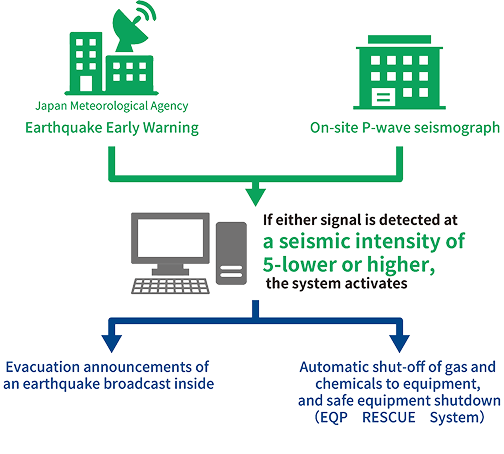
Earthquake Damage Mitigation System(EQP-Rescue)
In the event of an earthquake with a seismic intensity of 5 Lower or more, the Earthquake Damage Mitigation System (EQP-Rescue) broadcasts evacuation guidance to employees, automatically shuts off supplies of chemicals and gases to manufacturing equipment,and safely shuts down the equipment.
Resolved
Reducing Fire Damage Risks
Reducing Fire Damage Risks
(Ultra-High-Sensitivity Smoke Detector)
BPreparing for fires is also important, as a type of emergency that should be addressed by BCP*.
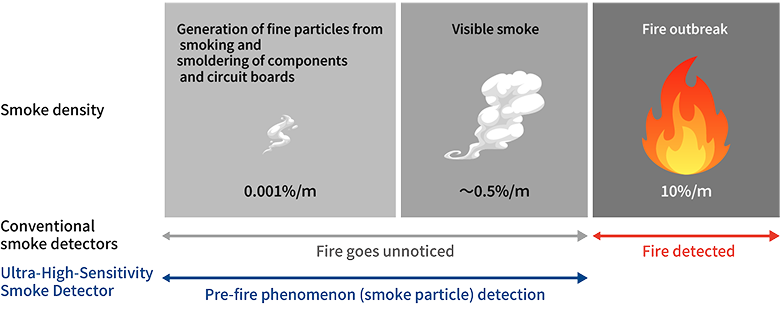
In semiconductor factories, hundreds of pieces of manufacturing equipment operate using electricity, and the most common causes of fire are electrical factors (such as short circuits, overcurrent, electrostatic sparks, and insulation breakdown). Early detection of these factors is crucial for minimizing damage.
Since conventional detectors only detect fires after they have started, there is a high risk that damage will spread and factory operations will be disabled. To address this, we have implemented measures to minimize damage by installing ultra-high-sensitivity smoke detectors, which detect smoke particles before a fire breaks out, so we can take action to minimize damage. *Business Continuity Plan
In semiconductor factories, hundreds of pieces of manufacturing equipment operate using electricity, and the most common causes of fire are electrical factors (such as short circuits, overcurrent, electrostatic sparks, and insulation breakdown). Early detection of these factors is crucial for minimizing damage.
Since conventional detectors only detect fires after they have started, there is a high risk that damage will spread and factory operations will be disabled. To address this, we have implemented measures to minimize damage by installing ultra-high-sensitivity smoke detectors, which detect smoke particles before a fire breaks out, so we can take action to minimize damage. *Business Continuity Plan